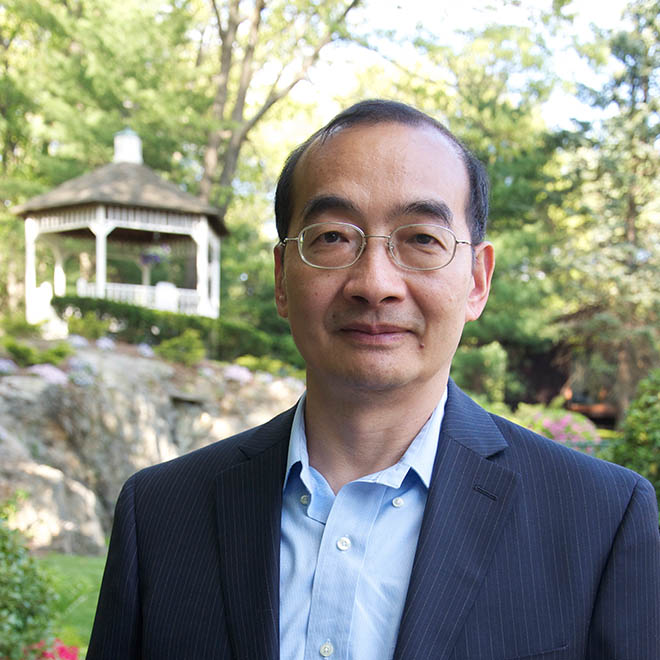
Horng-Tzer Yau Awarded 2026 Steele Prize for Seminal Contribution to Research
The American Mathematical Society (AMS) awarded the 2026 Leroy P. Steele Prize for Seminal Contribution to Research to Harvard Merton Professor of Mathematics Horng-Tzer Yau, László Erdős, and Benjamin Schlein. The prize is awarded for a paper—whether recent or not—that has proved to be of fundamental or lasting importance in its field, or a model of important research. Yau, Erdős, and Schlein received it for a series of three papers that introduced techniques that have led to a full understanding of fine spectral properties for many other ensembles of random matrices, such as those derived from sparse random graphs and related objects.
The papers develop a beautiful dynamical approach to the universality of the spectrum of random matrices at the local scale. The first two offer an inductive improvement of resolvent estimates as the imaginary part of the argument shrinks. The third paper marks the culmination of their argument and uses these resolved estimates as the starting point for the dynamical consideration of mixing of local statistics in a variant of Dyson’s Brownian motion.
Yau thanked his coworkers, the prize committee and the AMS for the honor. His research began when he was studying quantum mechanics and probability alongside Eliott Lieb and S.R.S. Varadhan. As they struggled with the delocalization conjecture for random Schrödinger operators and random matrices, they sought to first truly understand random matrices. “At the time, the excitement at Harvard surrounding the flow methods used in the Poincaré conjecture was palpable,” Yau recalled. “We asked ourselves whether the idea of “flowing to universality” could make sense in random matrices. This led us to study Dyson’s Brownian motion via the logarithmic Sobolev inequality—an important tool in probability theory and Poincaré conjecture.”
Yau’s research covers mathematical physics and probability theory, including quantum dynamics, partial differential equations, interactibe particle systems, and random matrices. He will be a plenary speaker at the 2026 International Congress of Mathematicians.